Warning signals can help us study adaptation. Often, warning signals are imitated by another organism (a mimic) because of the selective advantage to sending the same message to receivers. Mimicry is a rare instances where we can formulate a reasonable hypothesis about an adaptive optimum: the mimic’s fitness should be highest when it best resembles its model. Of course most adaptations will never be completely optimal: a variety of factors can prevent optimality. So-called “imperfect mimicry” provides a mirror we can hold up to evolution to better understand how these factors work.
Signals can also have consequences for ecology. Species may have mutualistic, antagonistic, or competitive relationships that are exacerbated or ameliorated by communication. This is key to understanding how the flow of information through a community affects the flow of energy and nutrients through it, forming a system of eco-evolutionary feedback.
Signals can also have consequences for ecology. Species may have mutualistic, antagonistic, or competitive relationships that are exacerbated or ameliorated by communication. This is key to understanding how the flow of information through a community affects the flow of energy and nutrients through it, forming a system of eco-evolutionary feedback.
1. How do communities affect signal evolution?
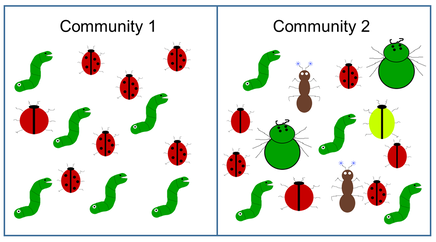 In simple community 1, predators can memorize all prey, so imperfect mimics stand out. But in community 2, they may instead switch to a simple rule: “avoid red.”
If you were a predator trying to figure out what to eat in your community, how would you change your behavior as its diversity increased? This question is important if we want to understand how mimicry evolves in different communities.
When prey are diverse, to make perfect decisions, predators would need to sample many different kinds of prey (risky!), and invest a lot in memorization. Instead, predators could economize with simple rules to identify prey.
Work in the journal eLife shows that imperfect mimicry is favored in diverse communities. Both high species richness and high species evenness increase selection for mimicry. This occurs because predators rely more on simple rules-of-thumb to generalize prey, such as “avoid red things” . Consequently, mimicry can evolve easily. This new line of work has the potential to explain broad patterns of diversity in warning coloration.
When prey are diverse, to make perfect decisions, predators would need to sample many different kinds of prey (risky!), and invest a lot in memorization. Instead, predators could economize with simple rules to identify prey.
Work in the journal eLife shows that imperfect mimicry is favored in diverse communities. Both high species richness and high species evenness increase selection for mimicry. This occurs because predators rely more on simple rules-of-thumb to generalize prey, such as “avoid red things” . Consequently, mimicry can evolve easily. This new line of work has the potential to explain broad patterns of diversity in warning coloration.
2. How does receiver psychology shape signal evolution?
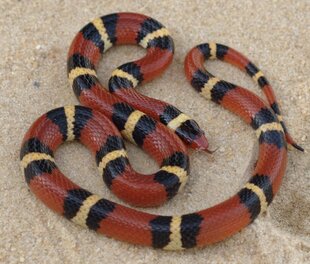
The ratio of red:black coloration on the eastern coral snake and scarlet kingsnake is a precise match. However, their order of colored rings is entirely different. This is a perplexing case of imperfect mimicry: mimicry is nonexistent in ring order. Why doesn't natural selection make this resemblance better? Two hypotheses: first, mimics might be trapped on a local adaptive optimum, unable to alter their ring order to match the coral snake without first having a ring-order mutation that would lower fitness. Second, predators might not see a difference in ring order. In a field experiment with plasticine replicas of coral snakes, mimics that differed in only ring order, and controls that differed in both, only controls were attacked at a higher rate. This supports the hypothesis that cognitive biases permit imperfect coral snake mimicry.
Our work on receiver psychology explores different cognitive biases that contribute to signal evolution. It also leverages Signal Detection Theory to understand how even in the absence of biases, predators must make decisions that allow some imperfect mimics to slip by. A field study shows that this may help facilitate the gradual evolution of mimicry from crypsis.
3. How do signals affect the structure of communities ?
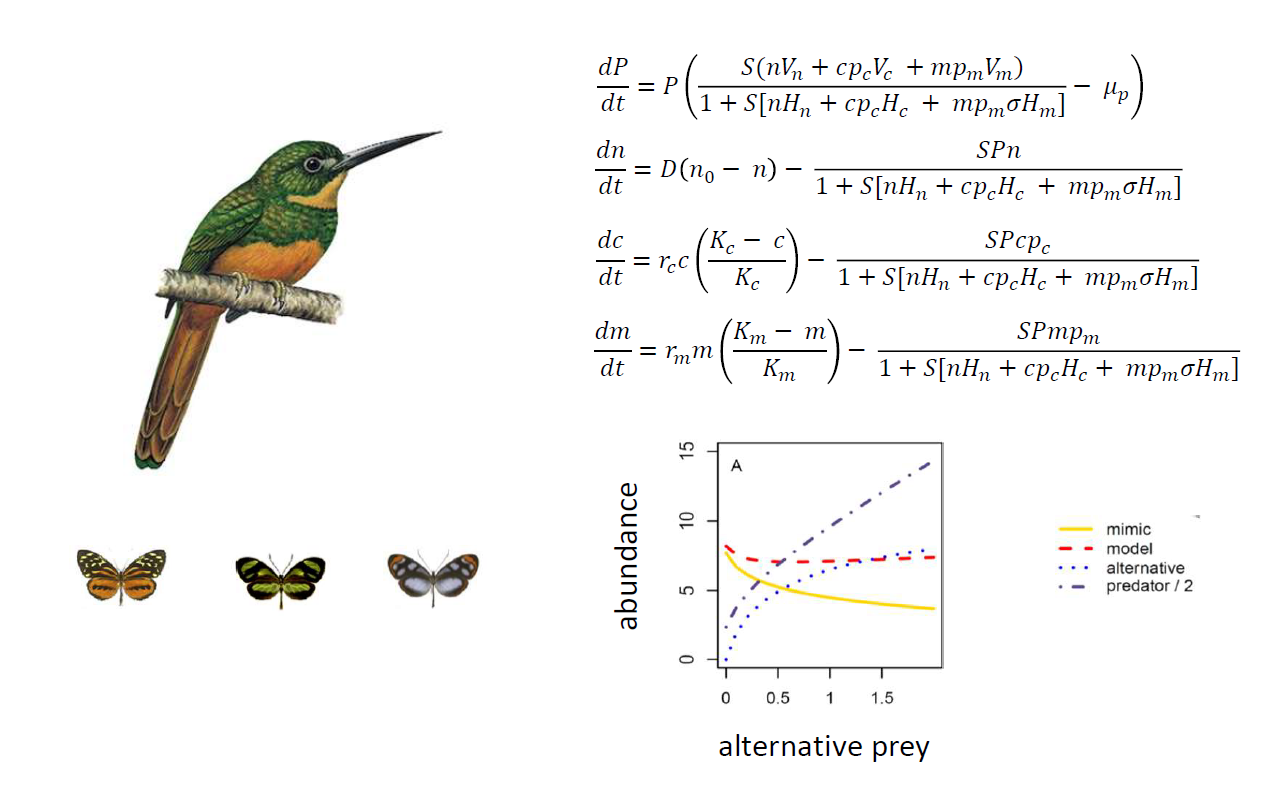
Signals must be favored by individual-level selection in order to evolve, but we do not know whether this translates in to an increase in population mean fitness, i.e. absolute fitness, or how it affects the populations of species that do not participate in communication. The answers to these questions can influence the composition of whole communities. New theory helps show some of the possibilities (Kikuchi et al. 2021 Biological Reviews, Kikuchi et al. American Naturalist 2022).
4. How are warning signals produced?
Mimics may converge on the phenotypes of their models using novel developmental systems. This may be necessary if unique structures or pigments are used in warning signals. It may also filter the species that can evolve to become mimics. Alternatively, mimicry may be widespread if mimics can co-opt deeply conserved developmental pathways to produce signals similar to those of their models. Coral snakes and their mimics use a color production system that is found among most snakes, perhaps explaining why about 20% of New World snakes mimic coral snakes.
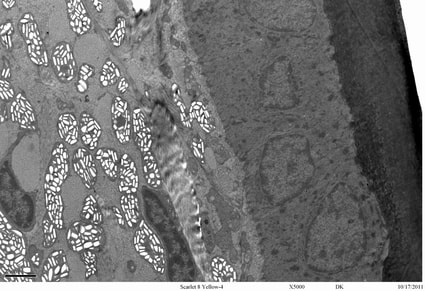
The clusters of white crystals in this cross section of yellow skin from a scarlet kingsnake are made from guanine. Their disorganized structure and small size reflects mainly short wavelengths.
|

Organic (top) and aqueous (bottom) pigment extracts from an eastern coral snake. Pink indicates the presence of drosopterins, the pigments responsible for the bright red hues of their warning signals.
|